HARMO
25131
From 2026 to 2029
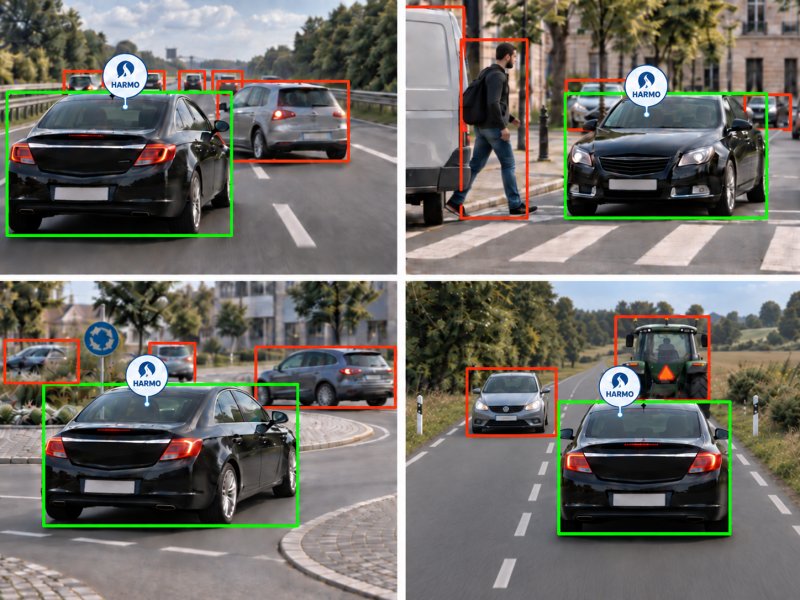
HARMO (Human-Aware Road Mobility Optimisation) develops and validates self-driving vehicles that take better account of how human driving behaviour changes with experience and familiarity with a route. TML leads the behavioural modelling and scenario-based validation, and translates the results into measurable safety and acceptance criteria.
Today, self-driving vehicles are often developed and tested using models in which human drivers behave in a relatively static manner. In reality, driving behaviour changes when drivers are familiar with a route: they allocate their attention differently, react more out of habit and may apply different safety margins. HARMO builds on the European projects i4Driving, BERTHA, HEADSTART, SUNRISE, and SYNERGIES, and explicitly incorporates these effects of learning, habituation, and route familiarity into models of human driving behaviour.
To this end, the project collects data from driving simulators and journeys in real traffic, and translates this into behavioural models that account for differences between familiar and unfamiliar situations. These models are used in simulations in which human and self-driving vehicles actually interact with one another. HARMO is also developing an AI planner that combines natural, human driving behaviour with explicit traffic and safety rules. Finally, realistic test scenarios, safety and acceptance criteria are being developed, and the models are being tested in real traffic in ‘shadow mode’: the system predicts what the vehicle and other road users would do, without taking control itself.
Within HARMO, TML is investigating how driving experience and familiarity with a route influence driving behaviour. We use data from driving experiments to simulate human driving behaviour in models and develop realistic traffic scenarios to test self-driving vehicles. Through simulations, we investigate how these vehicles respond to human driving behaviour and establish measurable criteria to assess their safety and predictability.
In addition, TML is developing the Acceptance Threshold Matrix, a method for assessing the extent to which the driving behaviour of self-driving vehicles is acceptable to drivers, passengers, and other road users.
In addition, TML is developing the Acceptance Threshold Matrix, a method for assessing the extent to which the driving behaviour of self-driving vehicles is acceptable to drivers, passengers, and other road users.