
Road safety assessment of a rush-hour lane at the E314 Aarschot – Leuven
23010
2023
TML carried out a road safety impact assessment for Agentschap Wegen en Verkeer to investigate the feasibility of a rush-hour lane on the E314 between Aarschot and Leuven. This included modelling the expected accidents, comparing alternatives, and valuing the effects, using both quantitative and qualitative methods.
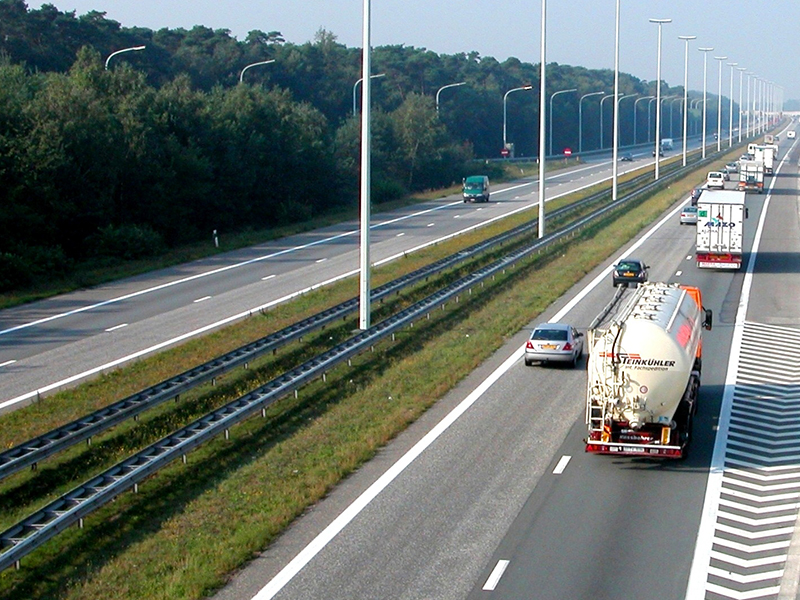
Agentschap Wegen en Verkeer (Agency for Roads and Traffic) investigated whether the current hard shoulder of the E314 motorway between the Aarschot complex (entry and exit) and the Vunt complex (exit) can be converted into a rush-hour lane in the direction of Leuven. A rush-hour lane is mainly constructed to increase the flow of traffic during peak times. It is less clear what the effects are in terms of road safety.
To verify this, TML conducted a road safety impact assessment of the planned measure. This type of assessment contains a number of prescribed parts, in particular: definition of the problem, current situation and a ‘do nothing’ scenario, road safety objectives, assessment of the road safety consequences of the proposed alternatives, comparison of the alternatives, and the presentation of the range of possible solutions and motivated choice. For this measure, TML modelled the expected evolution of the number of accidents. Taking into account all kinds of uncertainties, we made a monetary valuation of the effects, and we used a combination of a quantitative and qualitative approach.
The report is confidential.
Agentschap Wegen en Verkeer (Agency for Roads and Traffic) investigated whether the current hard shoulder of the E314 motorway between the Aarschot complex (entry and exit) and the Vunt complex (exit) can be converted into a rush-hour lane in the direction of Leuven. A rush-hour lane is mainly constructed to increase the flow of traffic during peak times. It is less clear what the effects are in terms of road safety.
To verify this, TML conducted a road safety impact assessment of the planned measure. This type of assessment contains a number of prescribed parts, in particular: definition of the problem, current situation and a ‘do nothing’ scenario, road safety objectives, assessment of the road safety consequences of the proposed alternatives, comparison of the alternatives, and the presentation of the range of possible solutions and motivated choice. For this measure, TML modelled the expected evolution of the number of accidents. Taking into account all kinds of uncertainties, we made a monetary valuation of the effects, and we used a combination of a quantitative and qualitative approach.
The report is confidential.